
Web Development w/ Google’s Go (golang) Programming Language
Learn Web Programming from a University Professor in Computer Science with over 20 years of teaching experience.
Así estudias: curso autodidacta
- Autodidacta y 100% en línea: contenido disponible 24/7.
- Avanzas a tu ritmo: la plataforma guarda tu progreso.
- Sin tutor ni clases en vivo: el curso está diseñado para estudiarse por tu cuenta.
- Te evalúas con actividades automáticas, sin entregas a un tutor.
Lo que serás capaz de hacer
This course requires you to download the Go programming language from the official website of the Go programming language. Additionally, this course may require the use of other software, such as PostgreSQL, Docker, and other tools. If you are a Udemy Business user, please check with your employer before downloading software. The Go programming language was created by Google to do what Google does : performant web applications at scale. Open-sourced in 2009 and reaching version one in 2012, the Go programming language is the best choice for web development programming today. Go is the most powerful, performant, and scalable programming language today for creating web applications, web API’s, microservices, and other distributed services. In this course, you will gain a solid foundation in web development . You will learn all of the following and more: Architecture networking architecture the client / server architecture the request / response pattern the RFC standards defined by the IETF the format of requests from clients and responses from servers Templates the role that templates play in server-side programming how to work with templates from Go’s standard library modifying data structures to work well with templates Servers the relationship between TCP and HTTP how to build a TCP server which responds to HTTP requests how to create a TCP server which acts as an in-memory database how to create a restful TCP server that handles various routes and methods the difference between a web server, a servemux, a multiplexer, and a mux how to use a third-party server such as julien schmidt’s router the importance of HTTP methods and status codes The net/http package streamlining your web development with the net/http package the nuances of the net/http package the handler interface http.ListenAndServe creating your own servemux using the default servemux http.Handle & http.Handler http.Handlefunc, func(ResponseWriter, *Request), & http.HandlerFunc http.ServeContent, http.ServeFile, & http.FileServer http.StripPrefix http.NotFoundHandler State & Sessions how to create state: UUID’s, cookies, values in URL’s, security how to create sessions: login, permissions, logout how to expire a session Deployment how to purchase a domain how to deploy an application to Google Cloud Amazon Web Services how to use Amazon Web Services (AWS) how to create a virtual linux machine on AWS EC2 (Elastic Cloud Compute) how to use secure shell (SSH) to manage a virtual machine how to use secure copy (SCP) to transfer files to a virtual machine what load balancers are and how to use them on AWS MySQL how to use MySQL on AWS how to connect a MySQL workbench to AWS MongoDB understanding CRUD how to use MongoDB & Go MVC (Model View Controller) Design Pattern understanding the MVC design pattern using the MVC design pattern Docker virtual machines vs containers understanding the benefits of using Docker Docker images, Docker containers, and Docker registries implementing Docker and Go deploying Docker and Go Google Cloud Google Cloud Storage Google Cloud no-sql datastore Google Cloud memcache Google Cloud PAAS App Engine Web Dev Toolkit AJAX JSON json.Marhsal & json.Unmarshal json.Encode & json.Decode Hash message authentication code (HMAC) Base64 encoding Web storage Context TLS & HTTPS JSON with Go using Tags By the end of this course, you will have mastered the fundamentals of web development. My name is Todd McLeod. I am tenured faculty in Computer Information Technology at Fresno City College and adjunct faculty in Computer Science at California State University Fresno. I have taught enough students over 22 years to know that by the end of this course, you will be an outstanding web developer. You will have the best skills available today. You will know the best way to do web development today. You will have the most demanded and highest paid skills in the marketplace. Join me in this outstanding course. Come learn best practices for web development. Sign up for this course now and open doors to a great future.
- Construct server-side applications using today's best practices
- Acquire an outstanding foundation in the fundamentals of web programming
- Learn from a University Professor in Computer Science with over 20 years of experience teaching individuals of all ability levels
- Achieve mastery in the understanding and application of web development
- Understand servers, routing, restful applications, JSON, templates, and file servers
- Understand cookies, state, UUIDs, HTTP methods, HTTP response codes, and sessions
Temario
UNIDAD 1 - Getting started · 5 leccionesUNIDAD 1 - Getting started
UNIDAD 1 - Getting started
- Why choose Go ( golang ) for web development?
- Course outline
- Language review
- How to succeed
- Miscellaneous resources
UNIDAD 2 - Templates · 14 leccionesUNIDAD 2 - Templates
UNIDAD 2 - Templates
- Understanding templates
- Templating with concatenation
- Understanding package text/template: parsing & executing templates
- Passing data into templates
- Variables in templates
- Passing composite data structures into templates
- Functions in templates
- Pipelines in templates
- Predefined global functions in templates
- Nesting templates - modularizing your code
- Passing data into templates & composition
- Using methods in templates
- Hands-on exercises
- Using package html/template, character escaping, & cross-site scripting
UNIDAD 3 - Creating your own server · 9 leccionesUNIDAD 3 - Creating your own server
UNIDAD 3 - Creating your own server
- Understanding servers
- TCP server - write to connection
- TCP server - read from connection using bufio.Scanner
- TCP server - read from & write to connection
- TCP server - code a client
- TCP server - rot13 & in-memory database
- TCP server - HTTP request / response foundation hands-on exercise
- TCP server - HTTP method & URI retrieval hands-on exercise
- TCP server - HTTP multiplexer
UNIDAD 4 - Understanding net/http package · 7 leccionesUNIDAD 4 - Understanding net/http package
UNIDAD 4 - Understanding net/http package
- net/http package - an overview
- Understanding & using ListenAndServe
- Foundation of net/http: Handler, ListenAndServe, Request, ResponseWriter
- Retrieving form values - exploring *http.Request
- Retrieving other request values - exploring *http.Request
- Exploring http.ResponseWriter - writing headers to the response
- Review
UNIDAD 5 - Understanding routing · 6 leccionesUNIDAD 5 - Understanding routing
UNIDAD 5 - Understanding routing
- Understanding ServeMux
- Disambiguation: func(ResponseWriter, *Request) vs. HandlerFunc
- Third-party servemux - julien schmidt’s router
- Hands-on exercises
- Hands-on exercises - solutions #1
- Hands-on exercises - solutions #2
UNIDAD 6 - Serving files · 9 leccionesUNIDAD 6 - Serving files
UNIDAD 6 - Serving files
- Serving a file with io.Copy
- Serving a file with http.ServeContent & http.ServeFile
- Serving a file with http.FileServer
- Serving a file with http.FileServer & http.StripPrefix
- Creating a static file server with http.FileServer
- log.Fatal & http.Error
- Hands-on exercises
- Hands-on exercises - solutions
- The http.NotFoundHandler
UNIDAD 7 - Deploying your site · 2 leccionesUNIDAD 7 - Deploying your site
UNIDAD 7 - Deploying your site
- Buying a domain - google domains
- Deploying to google cloud
UNIDAD 8 - Creating state · 13 leccionesUNIDAD 8 - Creating state
UNIDAD 8 - Creating state
- State overview
- Passing values through the URL
- Passing values from forms
- Uploading a file, reading the file, creating a file on the server
- Enctype
- Redirects - overview
- Redirects - diagrams & documentation
- Redirects - in practice
- Cookies - overview
- Cookies - writing and reading
- Writing multiple cookies & hands-on exercise
- Hands-on exercise solution: creating a counter with cookies
- Deleting a cookie
UNIDAD 9 - Creating sessions · 9 leccionesUNIDAD 9 - Creating sessions
UNIDAD 9 - Creating sessions
- Sessions
- Universally unique identifier - UUID
- Your first session
- Sign-up
- Encrypt password with bcrypt
- Login
- Logout
- Permissions
- Expire session
UNIDAD 10 - Amazon Web Services · 7 leccionesUNIDAD 10 - Amazon Web Services
UNIDAD 10 - Amazon Web Services
- Overview
- Creating a virtual server instance on AWS EC2
- Hello World on AWS
- Persisting an application
- Hands-on Exercise
- Hands-on Solution
- Terminating AWS services
UNIDAD 11 - Relational Databases · 6 leccionesUNIDAD 11 - Relational Databases
UNIDAD 11 - Relational Databases
- Overview
- Installing MySQL - Locally
- Installing MySQL - AWS
- Connect Workbench to MySQL on AWS
- Go & SQL - Setup
- Go & SQL - In Practice
UNIDAD 12 - Scaling On AWS · 8 leccionesUNIDAD 12 - Scaling On AWS
UNIDAD 12 - Scaling On AWS
- Overview of Load Balancers
- Create EC2 Security Groups
- Create an ELB Load Balancer
- Implementing The Load Balancer
- Connecting To Your MySQL Server Using MySQL Workbench
- Hands-on Exercise
- Hands-on Solution
- Autoscaling & CloudFront
UNIDAD 13 - Photo Blog · 5 leccionesUNIDAD 13 - Photo Blog
UNIDAD 13 - Photo Blog
- Starting Files
- User Data
- Storing Multiple Values
- Uploading Pictures
- Displaying Pictures
UNIDAD 14 - Web Dev Toolkit · 12 leccionesUNIDAD 14 - Web Dev Toolkit
UNIDAD 14 - Web Dev Toolkit
- Keyed-Hash Message Authentication Code (HMAC)
- Base64 Encoding
- Web Storage
- Context
- TLS & HTTPS
- JSON - JavaScript Object Notation
- Go & JSON - Marshal & Encode
- Unmarshal JSON with Go
- Unmarshal JSON with Go using Tags
- Hands-On Exercise Solution
- AJAX Introduction
- AJAX Server Side
UNIDAD 15 - Go & Mongodb · 9 leccionesUNIDAD 15 - Go & Mongodb
UNIDAD 15 - Go & Mongodb
- Organizing Code Into Packages
- Create User & Delete User
- MVC Design Pattern - Model View Controller
- Install Mongodb
- Connect to Mongodb
- CRUD with Go & Mongodb
- Hands on Exercise & Solution
- Hands on Exercise & Solution
- Hands on Exercise & Solution
UNIDAD 16 - Docker · 9 leccionesUNIDAD 16 - Docker
UNIDAD 16 - Docker
- Introduction to Docker
- Virtual Machines & Containers
- Installing Docker
- Docker Whalesay Example
- Using a Dockerfile to Build An Image
- Launching a Container Running Curl
- Running a Go Web App In a Docker Container
- Pushing & Pulling To Docker Hub
- Go, Docker & Amazon Web Services (AWS)
UNIDAD 17 - PostgreSQL · 24 leccionesUNIDAD 17 - PostgreSQL
UNIDAD 17 - PostgreSQL
- Installing Postgres
- Create Database
- Create Table
- Insert Records
- Auto Increment Primary Key
- Hands-on Exercise
- Hands-on Exercise - Solution
- Relational Databases
- Query - Cross Join
- Query - Inner Join
- Query - Three Table Inner Join
- Query - Outer Joins
- Clauses
- Update a Record
- Delete a Record
- Users - Create, Grant, Alter, Remove
- Go & Postgres
- Select Query
- Web App
- Query Row
- Insert Record
- Update Record
- Delete Record
- Code Organization
UNIDAD 18 - MongoDB · 17 leccionesUNIDAD 18 - MongoDB
UNIDAD 18 - MongoDB
- NoSQL
- MongoDB
- Installing Mongo
- Database
- Collection
- Document
- Find (aka, query)
- Update
- Remove
- Projection
- Limit
- Sort
- Index
- Aggregation
- Users
- JSON
- Create Read Update Delete (CRUD)
UNIDAD 19 - Farewell · 2 leccionesUNIDAD 19 - Farewell
UNIDAD 19 - Farewell
- Congratulations
- Bonus lecture
Certificado con validez SEP: lo emite la SEP, no solo una plataforma
Al demostrar la competencia recibes un certificado emitido por la Secretaría de Educación Pública a través del Gobierno del Estado de México: un documento oficial que puedes presentar con confianza ante cualquier empleador o institución.
Tu certificado con INEC
- Lo emite la Secretaría de Educación Pública (SEP), a través del Gobierno del Estado de México
- Documento oficial con folio verificable en línea
- Lo otorga la Universidad Tecnológica Fidel Velázquez
Otras plataformas en línea
- Constancia privada emitida por la misma plataforma
- Solo acredita horas cursadas o asistencia
- Sin respaldo de una autoridad educativa
Tu itinerario, de la inscripción al certificado
- 1
Inscripción con pago único
Pagas $2,800 MXN una sola vez y entras de inmediato al curso.
- 2
Estudias a tu ritmo
19 unidades con videos, lecturas y actividades, disponibles 24/7 durante 12 meses.
- 3
Cuestionarios por unidad
Cuestionarios para comprobar lo aprendido.
- 4
Certificado
Emitido por la SEP a través del Gobierno del Estado de México, con folio verificable.
Un certificado oficial de la SEP
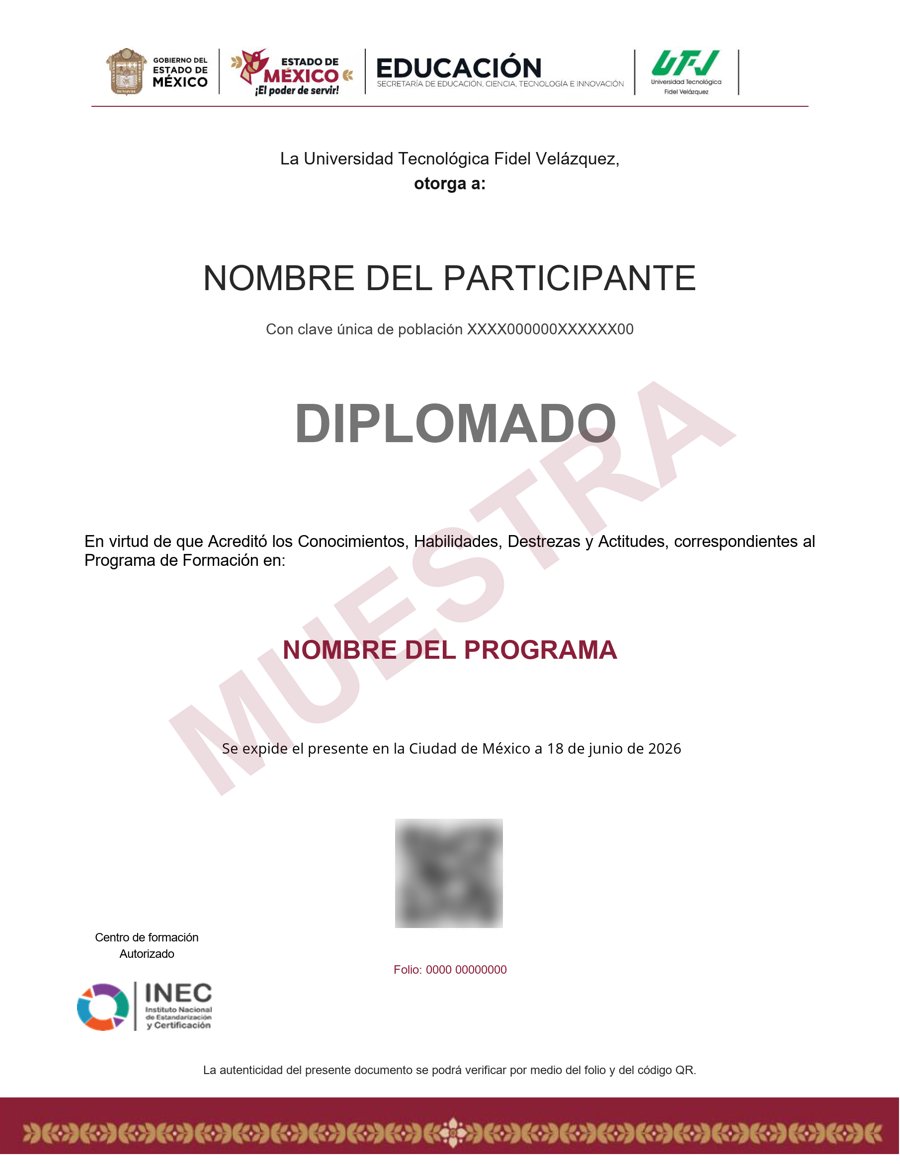
Muestra · verificable por folio y QR
- Emitido por la Secretaría de Educación Pública (SEP), a través del Gobierno del Estado de México. No es una constancia privada: es un documento oficial, y ese respaldo marca la diferencia frente a otras plataformas en línea.
- Contenido impartido por Todd McLeod.
- Folio y QR verificables para compartirlo con quien te contrate.
Empieza hoy, a tu ritmo
Un solo pago y acceso inmediato al curso completo durante 12 meses.
- 19 unidades · 173 lecciones · 60 h
- 12 meses de acceso
- Certificado emitido por la SEP (Gob. del Estado de México) con folio verificable
Sobre tu inscripción
¿Cómo es el pago?
Un solo pago de $2,800 MXN. No hay mensualidades ni cargos recurrentes.
¿Cuánto tiempo tengo acceso?
12 meses desde tu inscripción, 24/7, para avanzar a tu ritmo.
¿Quién imparte el contenido?
El curso es impartido por Todd McLeod; INEC gestiona tu inscripción, evaluación y certificado.
¿Qué pasa cuando vence mi acceso?
Puedes renovar tu cuenta tú mismo desde la plataforma, sin trámites ni esperas.
¿El curso tiene validez SEP?
Sí. Al completar el curso recibes un certificado emitido por la SEP a través del Gobierno del Estado de México, con folio verificable.
¿El curso tiene tutor o clases en vivo?
No. Es un curso autodidacta: estudias por tu cuenta, a tu ritmo, sin tutor ni sesiones en vivo.
¿Cómo se evalúa?
Te evalúas con actividades automáticas, sin entregas a un tutor.
Cursos relacionados
Incluido en la Membresía Educativa
Este curso forma parte de los 647 cursos autodidactas con certificado que incluye la membresía, por un solo pago anual.
Membresía Educativa: cursos en línea con validez SEP
